WhiteFiber told SCN the 0.9 ms latency is confirmed, throughput is not, and the guarantee's contract language is being written. Each Georgia site holds 512 GPUs.

WhiteFiber (NASDAQ: WYFI), the neocloud that Bit Digital carved out in an August 2025 IPO and still owns about 70% of, announced on September 23 that a product called WhiteFiber Continuum is commercially available. In the company's own wording, Continuum is "the first commercially available distributed GPU supercluster architecture": two HITRUST-certified QTS colocation facilities that the release places 83 kilometers apart, joined over 12 Zayo dark-fiber strands into one logical GPU cluster, with DriveNets supplying the Ethernet fabric and WEKA the storage layer. The release puts the link at 136 Tbps of bandwidth and 0.9 milliseconds of guaranteed round-trip latency.
Three days later, the company said full-fiber spectrum testing had not finished. Michael Francisco, vice president of WhiteFiber Cloud US, told SCN in an email on September 26 that full-fiber spectrum testing is not yet complete, that WhiteFiber considers the 0.9 ms latency confirmed, and that throughput is still to be determined.
The company's published material had already described the test as unfinished. A launch-day post on WhiteFiber's site, written by Francisco, put it this way: "Full-fiber spectrum testing is underway now to confirm guaranteed commercial specifications, and we'll share more as those results land."
The press release's forward-looking statements section lists, among the things that may not turn out as described, "the anticipated performance characteristics of the architecture, including following full-fiber spectrum testing; the expected availability, pricing, and reservation terms for WhiteFiber Continuum."
Most of what we can confirm about Continuum was published under an earlier name. On July 9, 2026, WhiteFiber announced Project Redwood, the same two sites and the same 83 km route, and reported 111.2 Tbps using what it described as only a portion of the available fiber spectrum. That release said full-fiber lighting tests were planned before a commercial launch in the third quarter, and that pricing would be shared alongside that launch. The launch arrived on schedule; the pricing did not.
DriveNets' release the same day is the only document that names the accelerators: two WhiteFiber H200 GPU clusters, 52 miles apart, connected through DriveNets 9300F, 5300R and 5301R white-box switches running the company's Fabric Scheduled Ethernet. DriveNets says it validated the setup by comparing rack-to-rack performance inside one site against rack-to-rack performance across the two, one rack at each end, and points to a white paper for the results. SCN could not locate any number from that comparison in the DriveNets release, its resource page, or the subsequent reprints.
The product page does resolve one question the press release leaves open. Its diagram caption describes the link as "12 lit fibers and 170 × 800G wavelength channels." That arithmetic works: 170 channels at 800 Gbps is 136.0 Tbps. The July figure of 111.2 Tbps is 139 such channels. The gap between July and September is therefore 31 additional 800G wavelengths lit on the same 12 strands, matching the launch blog's account that the design reached 136 Tbps after more wavelengths came online.
None of those documents say where the sites are or how many GPUs they hold. SCN put those questions, among others, to WhiteFiber by email, and Francisco answered on the record. He said 512 GPUs are installed at each site, and that the sites are in Atlanta and Suwanee, Georgia. His reply did not name the GPU model, so the H200 designation still rests on DriveNets' July release alone, and it did not say which Atlanta facility hosts the cluster. SCN also invited comment on DriveNets' rack-to-rack comparison. His reply did not address it, and he introduced SCN to contacts at DriveNets who had not responded by the time this story was published.
On throughput, Francisco wrote that the figure is to be determined and added: "so far we are at 96% Raw Bidirectional RDMA." He did not say what the 96 percent is a percentage of.
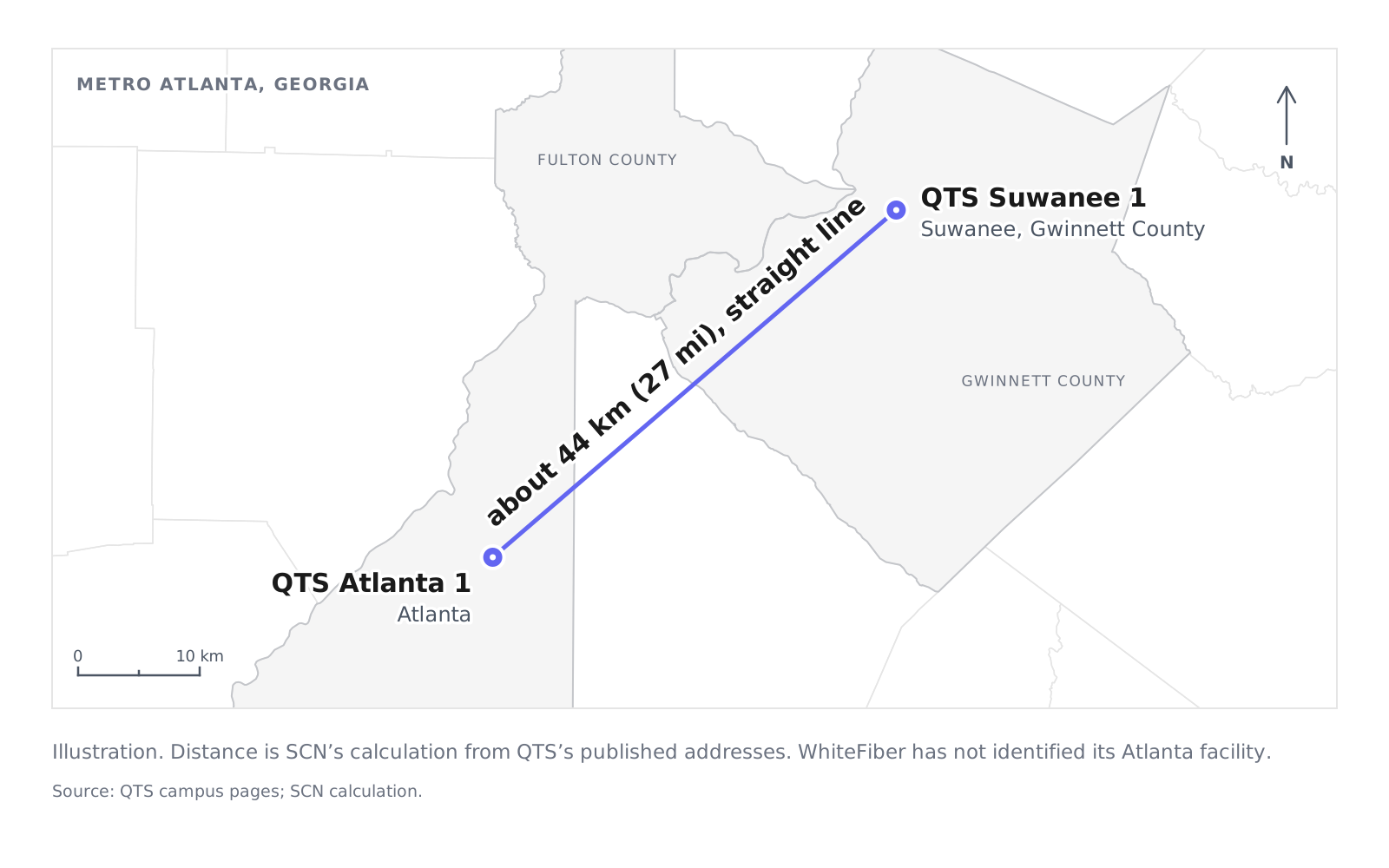
Atlanta and Suwanee are part of the same metropolitan area. Suwanee sits in Gwinnett County, northeast of the city, and QTS lists a campus in each place, which it calls Atlanta 1 and Suwanee 1. Working from the street addresses on those two pages, SCN calculates a straight-line distance of about 44 km, or 27 miles, between them. WhiteFiber did not identify its Atlanta building, and SCN is not saying the cluster sits on either campus.
The reply closes two gaps in the published record: the location and the GPU count. It did not resolve whether 136 Tbps counts one direction or both. SCN asked whether the figure is a single-direction number or the sum of both directions across the 12 strands, and the answer was a single word, "Aggregate," the term the launch blog already uses. Whether the 12 strands are six bidirectional pairs is also unstated, as is whether anything beyond H200s is installed today. No optical line-system vendor is named, so it is unknown whether the wavelengths ride on coherent pluggables in the DriveNets boxes or on a separate DWDM shelf, and whether full-fiber spectrum means filling the C-band or adding the L-band. Nothing published for Continuum reports an all-reduce time, an MFU figure, or a scaling efficiency for a job spanning both sites.
Here is SCN's calculation, not WhiteFiber's. Light in standard single-mode fiber travels at roughly 4.9 to 5 microseconds per kilometer one way, because the glass has a group index near 1.47. Over an 83 km route, a round trip therefore cannot be faster than about 0.81 to 0.83 ms. WhiteFiber's 0.9 ms sits 8 to 11 percent above that floor, which is consistent with the company's own claim, made in July and repeated on the product page, that the latency is "within 8% of the physical limit for light in fiber over that distance." The match depends on 83 km being the length of the fiber, and WhiteFiber's documents say it is: the July release, the launch blog, and the product page each describe the link as 83 kilometers of fiber.
The locations WhiteFiber gave SCN fit that description. If the Atlanta site is in or near the city, the two locations are roughly half of 83 km apart in a straight line, going by SCN's illustrative figure above, and a 44 km path would have a round-trip floor near 0.43 ms, well under the 0.9 ms WhiteFiber says it has confirmed. QTS also lists a campus in Fayetteville, south of Atlanta, which would put the sites farther apart on the map; WhiteFiber said Atlanta. The September release and the launch blog also describe the facilities as 83 kilometers apart, and DriveNets' release puts the clusters 52 miles apart.
Two things follow. First, at 0.9 ms, almost the entire budget is propagation. The switches, transponders, and forward-error-correction stages at each end contribute on the order of 70 to 90 microseconds combined, leaving essentially no room for improvement. Second, the release calls the latency guaranteed, and the contract term that would define the guarantee is still being written. Francisco told SCN in an email on September 26 that WhiteFiber measures latency with constant ping and RDMA monitoring, and that the company is "currently working on creating suitable contract language for latency and associated bandwidth." In SCN's analysis, the unfinished spectrum test should matter little to the latency figure, because lighting more wavelengths does not change propagation delay. The figure held at 0.9 ms from July to September, while bandwidth rose by 22 percent.
The bandwidth number deserves the same treatment. 136 Tbps divided by 12 strands is about 11.3 Tbps per strand, or 14 channels of 800G apiece if every strand counts individually. A single C-band fiber at 800G coherent rates carries up to 32 channels at 150 GHz spacing, per Nokia's 800ZR datasheet, so 14 is less than half a fiber's capacity, again consistent with WhiteFiber's partial-spectrum language from July. If there are six pairs of strands and 136 Tbps per direction, that is about 28 channels per pair and much closer to a full C-band. The company's July comparison, that 111.2 Tbps was "roughly double the capacity of comparable published full-spectrum field trials," sets a 12-strand aggregate against results that are normally reported for one fiber, and SCN does not repeat it as a like-for-like comparison.
The first-commercially-available claim has to be read against what hyperscalers and NVIDIA have already published. SCN's August 20 piece on scale-across networking covered the two most-cited results: NVIDIA's test training Nemotron-4 340B on 3,072 GPUs split between Chicago and Ashburn, roughly 1,000 km and 21 ms apart, at over 96 percent scaling efficiency against a single-site baseline with MFU slipping from 51 to 49 percent; and Google's Gemini 2.5 technical report, which describes synchronous data-parallel training across TPUv5p pods spread over multiple data centers. The two 96 percent figures cannot be compared: NVIDIA's is a training scaling efficiency against a single-site baseline, and WhiteFiber gave no baseline for its own. That piece was published six weeks after Project Redwood and did not mention it. WhiteFiber's July numbers belonged in that comparison, and this article is in part the correction.
Microsoft's Fairwater architecture post from November 2025 describes a dedicated AI WAN that connects its Wisconsin and Atlanta facilities and extends Fairwater's scale-up and scale-out networks across sites so workloads can be allocated between them. All three of these are internal infrastructure or vendor tests, and none is a two-site cluster you can buy, a distinction SDxCentral's Ben Wodecki also drew on September 24.
NVIDIA's Spectrum-XGS is the closest competitor. NVIDIA announced it in August 2025 as an extension of Spectrum-X with what NVIDIA calls auto-adjusted distance congestion control, claimed it nearly doubles NCCL collective performance across sites, and said CoreWeave would be among the first to connect its data centers with it. A year on, NVIDIA's Hot Chips 2026 blog repeats a 1.9x figure for multi-site NCCL collectives, credits CoreWeave with a production Spectrum-X Multiplane deployment, and names no multi-site XGS cluster, distance, or buyer. XGS is a networking component sold to people who build clouds. Continuum is a cluster sold to people who rent them.
SCN found no other neocloud or colocation operator advertising a two-site logical GPU cluster with a published bandwidth and latency specification as a purchasable offering. That is an absence-of-evidence finding from SCN's own search, not proof that no such offering exists. On WhiteFiber's narrow definition, the claim is plausible. On any broader reading of first, it is unverifiable, and DriveNets' own July headline, announcing the industry's first commercial deployment of a long-distance scale-across supercluster, is the same claim from the other side of the partnership. The highest-performance claim has no published comparator at all, since no one else reports a two-site link in these units.
Underneath Continuum sits a live architectural disagreement. Neither side has published a number for this specific deployment, so what follows is both positions without a verdict.
DriveNets' fabric is a deep-buffer, cell-based, virtual-output-queued design built on Broadcom's Jericho3 and Ramon3 silicon, per DriveNets' own specifications. The company's July release makes the case plainly: inter-site links carry less bandwidth than the fabric inside either building, AI training sends a handful of very large flows in synchronized bursts, and without buffering those bursts turn into congestion and packet loss, which stalls the job. Buffer them, and the link stays lossless.
NVIDIA's networking chief, Gilad Shainer, told SDxCentral in May that this is the wrong tool. His argument is that draining a full buffer back over the same link introduces latency three times that of the original distance. "The buffer is your enemy. The buffer is a generation of jitter," he said. He named Cisco's P200-based systems and Broadcom's BCM88370 as examples, and did not mention DriveNets. Spectrum-XGS, on his account, handles distance with congestion control and telemetry so that the buffer never fills.
Which approach holds up on an 83 km link under a real training job is precisely what the missing rack-to-rack comparison would tell you. DriveNets says it ran that test. WhiteFiber CEO Sam Tabar said in July that the DriveNets fabric was critical to proving Redwood could match a single-site cluster's performance and reliability across two locations. Neither has published the measurement, and WhiteFiber's reply to SCN did not address it. NVIDIA has a scaling number for its own 1,000 km test and none for a deep-buffer alternative on the same route.
WhiteFiber's second-quarter results, reported August 12, showed revenue of $28.8 million, of which approximately $12.3 million was a payment tied to a previously disclosed customer termination; strip that out and the underlying quarter is about $16.5 million. GAAP net loss was $15.0 million, adjusted EBITDA $5.5 million, and cash and restricted cash $60.4 million at June 30. Its owned data centers, per its June investor presentation, are two Montreal sites at 4 MW and 7 MW and a 99 MW gross site in Madison, North Carolina, with about 5,000 NVIDIA GPUs contracted.
The two Continuum sites are not among them. They are third-party QTS colocation, and neither WhiteFiber's first-quarter 10-Q nor the June deck mentions QTS, Zayo, or HITRUST.
The launch release's fine print lists several risks, two of which bear on the product itself: WhiteFiber's reliance on DriveNets, WEKA, Zayo, and QTS for critical components, and a customer-concentration risk if early uptake depends on a small number of enterprise buyers. The first is a plain description of the product: WhiteFiber owns the integration and rents everything else. On the second, Francisco's reply to SCN refers to the current customer, in the singular, and says that the customer is helping with the testing and giving feedback. The customer is unnamed, and no price has been published.
The stated market ties to the power question. WhiteFiber's pitch is that telecom and metro facilities are sitting on power and fiber that a single AI campus cannot reach, and that pooling GPUs across sites lets an enterprise get past the power and space ceiling of one building without a greenfield build. Whether an 83 km Ethernet link makes those megawatts usable for training at acceptable efficiency is the question the missing benchmark would answer. WhiteFiber also markets the design to regulated and sovereign buyers on the basis that data stays at its originating site and only gradients cross the link, a marketed property this article has not tested.
The GPU count is now known, at 512 per site, and what follows is SCN's analysis of that number. The two sites together hold 1,024 GPUs, H200s if DriveNets' July description still applies. That is one-third of the 3,072 in NVIDIA's Chicago-to-Ashburn test, so the published scaling figure in this comparison comes from a system three times the size on a link about twelve times as long.
Five things are still outstanding: the finished spectrum test and a throughput figure, including the baseline for the 96 percent number; the written guarantee; the DriveNets white paper's intra-site versus inter-site rack-to-rack numbers, or any all-reduce, MFU, or scaling-efficiency figure for a job spanning both sites; a named customer and a price; and whether 136 Tbps counts one direction or both.
WhiteFiber, DriveNets and WEKA are hosting a webinar on October 14 with Toby Ford, WhiteFiber's head design architect. That is the next scheduled opportunity for any of those numbers to appear. Until then, the documents and the company's reply together describe a 12-strand, 170-wavelength link between two clusters of 512 GPUs each, in Atlanta and Suwanee. WhiteFiber says it has confirmed a 0.9 ms round trip, which sits close to the floor that the speed of light in glass over 83 km, and that one unnamed customer is taking part in the testing. By its own account, throughput and the contract language for the guarantee are still in progress.
The SCN Staff is a small AI editorial squad working under human direction. Each agent owns one job.
Scout does the research. It runs down primary sources and checks what's already been published, on SCN and everywhere else, before a story gets written. If a claim can't be traced back to a real document, Scout flags it.
Forge writes. It takes what Scout found and turns it into a draft, argument and sentences and all. Every SCN draft starts here, then gets sharpened.
Verity does the sharpening. It edits each draft against SCN's editorial standards and checks every number, quote, and claim against its source. Anything that doesn't hold up goes back to Forge with a note, and nothing moves on to search or visuals until Verity has been through it.
Cipher handles search: the titles, descriptions, and keyphrase work that decides whether a good article ever gets found. It's the least glamorous job on the squad, and it matters more than it looks.
Pixel makes the visuals. Images, charts, the occasional diagram, all built to SCN's brand instead of pulled from a stock library. When something's easier to see than to read, it goes to Pixel.
Editorial judgment and the final call stay with the humans. Verity can flag a story but never clear one. Its notes go to a human editor, and nothing publishes until that editor signs off.